Working Mono · an AI-native firm

Hire RevOps into a system, not a tool pile.

A great RevOps lead is worth the search. What most inherit is a pile of Zapier runs, Clay tables, and HubSpot fields nobody trusts. PATCH runs the function while you recruit, then hands your hire an owned, readable system and a year they don't spend untangling.

We do the work. You own the machine. Running before the job posting closes.

Proof

30+Commercial systems delivered
Month 1Foundation live, guaranteed
100%Owned by you
270+Workflow patches shipped to client systems
Attio Founding Expert Partner
Trusted by AI-native teams Granola Reducto Cache Vetrec
The definition

First RevOps hire or an agency: which comes first? The system first, then the hire into it.

A strong RevOps lead is one of the best hires a scaling B2B team makes, and most arrive to a tool pile that costs them their first year. Working Mono runs the RevOps function from month one, builds the owned system in your repo and warehouse, then hands your eventual hire a machine they operate instead of excavate.

How it compounds

What your RevOps hire walks into. A loop already turning.

By the time your RevOps lead signs, the loop below has been running for months: memory built, workflows shipping, reports landing weekly. Day one is a repo tour, not a forensic audit.

Step 01

Map what the hire would inherit

A new RevOps lead spends their first weeks interviewing everyone and reading old automations to work out what exists. AI Terrain Mapping does that before recruiting starts: interview agents debrief your team while we inspect the CRM, billing, product analytics, and support systems directly, and the findings land as a map anyone can challenge.

Output: the inherited stack, charted before anyone inherits it

Step 02

Build the memory they'd ask for

Instead of logic scattered across n8n runs, Airtable bases, and enrichment tabs, revenue data gets joined into one model in your warehouse: product usage, CRM, billing, and support, traceable to source end to end. Every RevOps lead wishes this artifact existed on their first day.

Output: one revenue model, waiting in your warehouse

Step 03

Run the operating cadence

The question every RevOps function exists to answer, what deserves attention this week, gets answered by the system itself: unowned PQLs, wobbly renewals, expansion signals nobody has touched. Founders read the queue directly until there is a hire to own it.

Output: the weekly priority queue, running pre-hire

Step 04

Ship what they'd backlog

Routing, scoring, enrichment, lifecycle, alerts: each ships as verified code to your repo on a weekly cadence. A solo RevOps hire triages that list for a year. Here it ships while you interview, and your lead re-orders it later with full context.

Output: production workflows, live before the offer letter

Step 05

Write the paper trail

Every workflow reports what it surfaced and what pipeline it touched, and every decision lands in the repo docs as it is made. The audit trail a skeptical new lead needs in order to trust an inherited system exists because it was written while the system was built.

Output: a decision log your hire can audit

Step 06

Hand the keys to the hire

When your RevOps lead arrives, they inherit the memory, the workflows, the docs, and the cadence, then start changing things. We shift to building what they spec, drop to advisory, or step away entirely. The machine answers to them either way.

Output: a hire productive in week one, not quarter two

The RevOps function, running this month. Recruit on your own clock.

Book a 20-minute call
Ask, then act

One revenue memory. Every surface.

GTM inputs
attio
stripe
metronome
clearbit
apollo
snowflake
segment
postgres
slack
hubspot
mixpanel
intercom
zendesk
linear
bigquery
salesforce
posthog
amplitude
+ and more
Month one

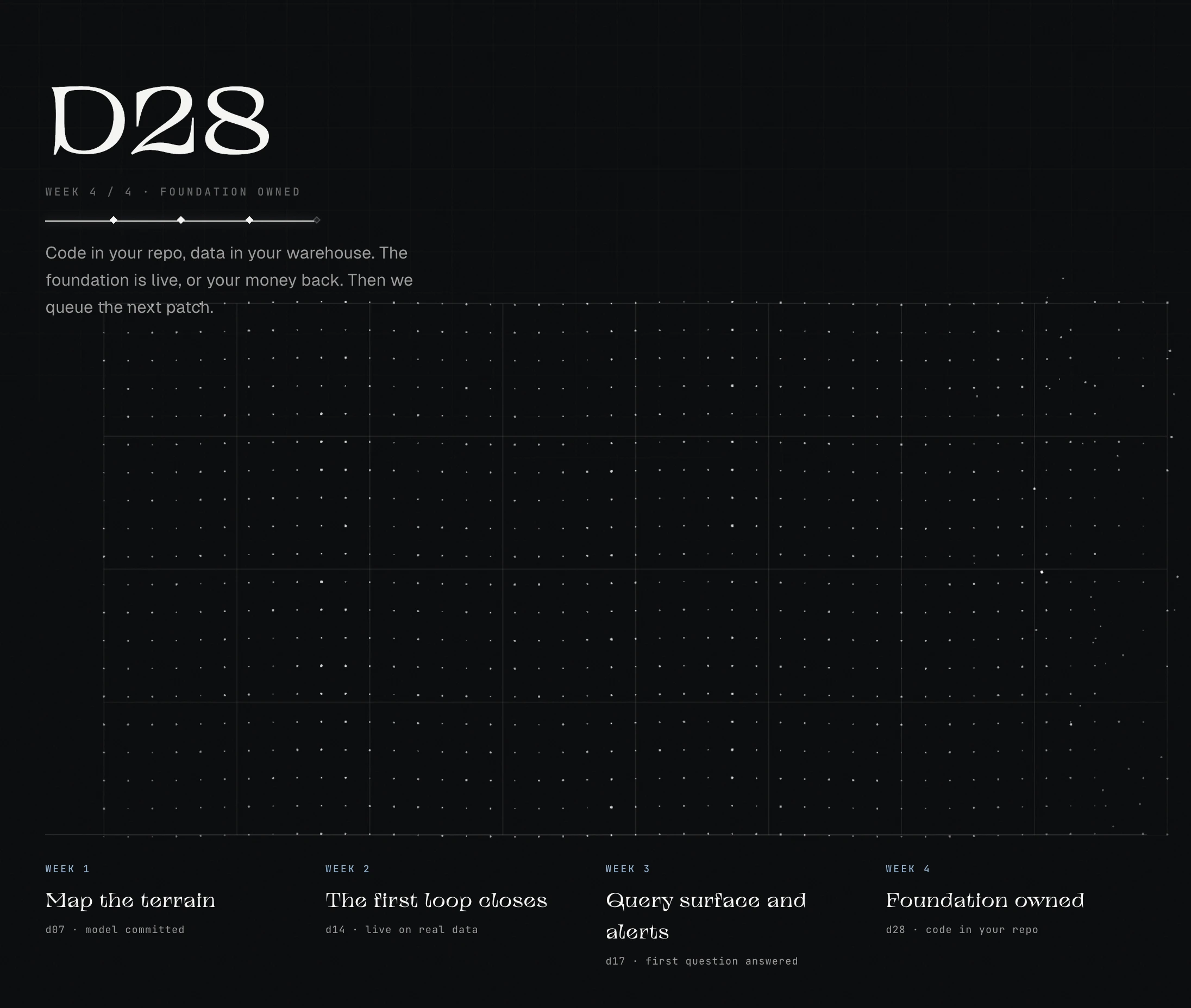
Month one runs the function. The hire arrives to a machine.

While the job description is still in draft, the foundation goes live: warehouse up, first workflow running, weekly cadence started, and every commit in a repo your future lead will read on day one.

Week 1

Chart the stack

We map the tool pile a hire would inherit: every automation, field, and formula, checked against what the data proves.

Week 2

Join the data

Product usage, CRM, billing, and support land joined in your warehouse. The revenue questions get one answer instead of four.

Week 3

Cadence starts

The first workflow ships and the weekly rhythm begins: priorities surfaced, actions routed, results reported.

Week 4

Ready for the hire

Docs, runbooks, and every decision committed. If the foundation isn't live by day 28, we refund the month, and the job spec just got easier to write.

You own the machine.

Nothing here belongs to us. The code sits in your repo, the data in your warehouse, the workflows on your infrastructure, and the docs read like an onboarding guide because that is what they are. When your RevOps lead starts, ownership doesn't transfer. It was theirs before they arrived. Cancel any month and the system keeps running. Keep us, and their roadmap ships faster.

In production

Real systems, running today.

The ledger below is live: 30+ owned commercial systems running weekly, each one built from day one to be handed to the team that owns it.

The next step

Sequence the hire around the system.

In 20 minutes you'll leave with an order of operations: what runs from month one, when the RevOps hire makes sense for your stage, and what their first week looks like walking into a documented machine.

prefer email? contact@workingmono.com