Working Mono · an AI-native firm

Owned GTM. Your commercial system, held as an asset.

Rented GTM traps revenue logic in per-seat platforms: the rules live in HubSpot, Zapier, and Clay and leave when you stop paying. Owned GTM makes the system an asset: your repo holds the code, your warehouse holds the data, your team and your agents read the same docs. We named it. We build it.

We do the work. You own the machine. Owned in full from the first commit.

Proof

30+Commercial systems delivered
Month 1Foundation live, guaranteed
100%Owned by you
270+Workflow patches shipped to client systems
Attio Founding Expert Partner
Trusted by AI-native teams Granola Reducto Cache Vetrec
The definition

What is Owned GTM? A commercial system you hold, not lease.

Owned GTM is the practice of running go-to-market on infrastructure the company holds as an asset: workflow code in the company's repo, revenue data in its warehouse, logic and documentation readable by the team and its AI agents alike. Vendors become replaceable frontends. Cancel any of them and the system keeps working, because the company holds the asset.

How it compounds

How Owned GTM compounds. Every cycle deposits into the asset.

A rented stack resets to zero every time you switch vendors. An owned system accrues: each workflow shipped, each join hardened, each doc written adds to what the team, and the agents beside it, can act on.

Step 01

Audit what you actually own

Most teams discover they own less than they think: scoring buried in a vendor's UI, routing in a founder's head, reports in screenshots. AI Terrain Mapping interviews your stakeholders while reading the systems themselves, and returns a map of what is owned, what is rented, and what is simply lost.

Output: the ownership map, first commit in your repo

Step 02

Move the memory into your warehouse

Product usage, CRM, billing, and support join into one source-traceable Commercial Memory in a warehouse you control. The per-seat tools keep their jobs as frontends. The record of how your revenue actually works stops living inside any of them.

Output: Commercial Memory, held in your warehouse

Step 03

Point the system forward

Once the memory is yours, foresight gets cheap. The system reads what changed this week, weighs it against your goals and ICP bets, and surfaces the next actions worth taking, with the reasoning written down where your team can challenge it.

Output: a ranked action queue with its reasoning attached

Step 04

Ship workflows you keep

Routing, enrichment, lifecycle, outbound: each ships as a workflow patch, written as code and merged to your repo. When you change vendors, nothing evaporates: the workflow logic was never theirs to keep. 270+ patches shipped to client systems this way.

Output: a production workflow, merged and yours

Step 05

Read the weekly ledger

Every patch reports the revenue it touched, and the report is queryable rather than trapped in a dashboard tab. Over months this becomes something rented stacks never produce: a full account of what your GTM did, when it did it, and why.

Output: a weekly ledger you query, not screenshot

Step 06

Let the asset compound

Owned systems appreciate. The memory absorbs your conventions and exceptions, the docs teach each new hire and each new agent, and every workflow builds on the ones shipped before it. Six months in, no fresh deployment can catch what the system already knows.

Output: an asset that is sharper every month

Own the engine before the next renewal cycle. 20 minutes to map the path.

Book a 20-minute call
Ask, then act

One revenue memory. Every surface.

GTM inputs
attio
stripe
metronome
clearbit
apollo
snowflake
segment
postgres
slack
hubspot
mixpanel
intercom
zendesk
linear
bigquery
salesforce
posthog
amplitude
+ and more
Month one

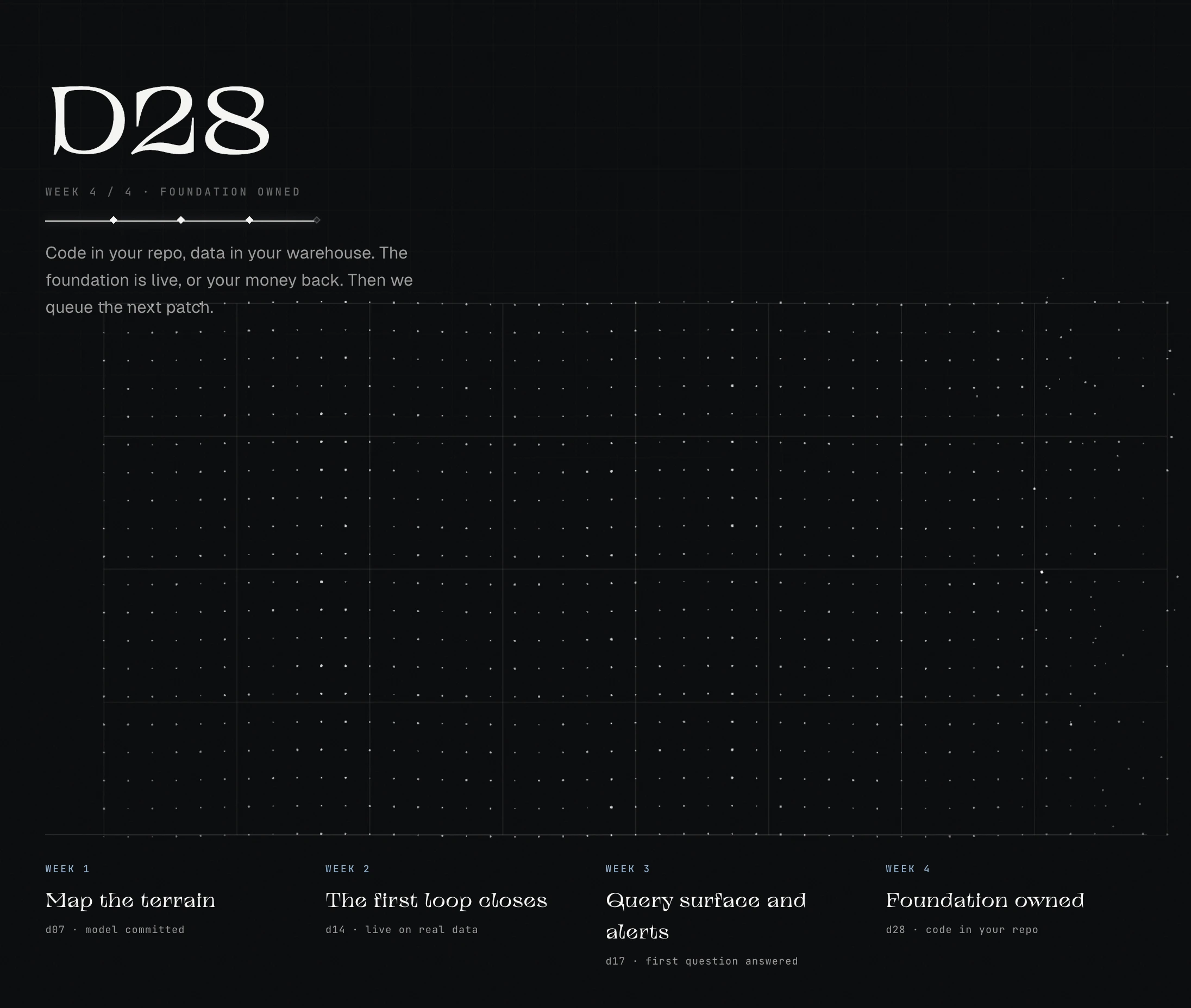
Month one moves the asset into your name. Weekly patches raise its value.

Ownership is a set of artifacts with your name on them by day 28: a live warehouse, a joined memory, a running workflow, and a repo your engineers can clone.

Week 1

Audit the estate

We mark what is owned, rented, and lost across your stack, then stand up the warehouse and repo the system will live in.

Week 2

The first owned workflow

The workflow you rely on most gets rebuilt as code on your infrastructure and runs against live data beside the rented one.

Week 3

Memory and queries live

The joined memory goes queryable. Your team asks revenue questions in plain language and gets answers traced to source.

Week 4

Title transferred

Repo, warehouse, workflows, docs: all in your accounts, all under your control, or your money back. The rent stops mattering.

You own the machine.

This is the whole point of the category: the deliverable is an estate, not a subscription. Workflow code merged into your repo, the memory living in your warehouse, every automation running on your infrastructure, and the docs written so a new hire or a new agent can pick it up cold. Cancel any month and the system keeps running. Staying is what makes it compound.

In production

Real systems, running today.

The category is already in production: 30+ owned commercial systems delivered, each one held by the client running on it.

The next step

Let's move your GTM onto your own books.

Walk us through your stack. We'll mark what you own against what you rent and sketch the shortest path to an owned foundation, live inside a month.

prefer email? contact@workingmono.com