Working Mono · an AI-native firm

RevOps that turns growth signal into pipeline.

Your product knows who is ready to buy; the handoff is where that dies. PQL definitions live in a notebook, scoring in a spreadsheet, routing in a Zapier chain nobody trusts. We build the handoff as code on one joined model in your warehouse, and every experiment feeds the memory the routing reads.

We do the work. You own the machine. First route live inside month one.

Proof

30+Commercial systems delivered
Month 1Foundation live, guaranteed
100%Owned by you
270+Workflow patches shipped to client systems
Attio Founding Expert Partner
Trusted by AI-native teams Granola Reducto Cache Vetrec
The definition

What does RevOps look like for a growth team? One model both teams trust.

For a growth team, RevOps is the handoff made mechanical: product events, CRM, and billing joined in one model, PQL definitions written as tested code instead of tribal knowledge, routing that fires the moment a threshold crosses, and every experiment logged to the same memory, so what growth learns changes what sales does this week, not next quarter.

How it compounds

The signal-to-pipeline loop. Instrumented end to end.

Definitions, scoring, routing, and experiments run against one joined model in your warehouse. Every weekly patch is judged by what reached sales and what it closed, and the loop tightens on that evidence.

Step 01

Map the signal path

We interview growth, sales, and ops while reading Segment, the CRM, and billing directly, then chart where signal actually dies: the PQL definition three people remember differently, the score nobody recomputes, the routing rule that quietly stopped firing in March.

Output: the signal path, charted end to end

Step 02

Join product to pipeline

Events, accounts, opportunities, and revenue join into one model in your warehouse, with identity resolution handled once instead of per-tool. A PQL stops being a spreadsheet tab and becomes a queryable row with its full history attached.

Output: one joined model under growth and sales

Step 03

Define PQLs as code

Qualification logic becomes versioned, tested code: thresholds, exclusions, decay, and the reasoning in the comments. When the definition changes it changes in one place, recomputes the queue, and shows the diff: who entered, who dropped, and why.

Output: PQL logic you can test and diff

Step 04

Ship the handoff

Scored accounts route to owners in Attio or HubSpot with context attached: the triggering signal, the usage trend, the billing state, the suggested play. Alerts land in Slack as thresholds cross, so sales acts the same day growth generates the signal.

Output: the handoff, live as routing code

Step 05

Measure what converts

The weekly trace follows the funnel you actually run: signals fired, routed, worked, converted. Thresholds earn their values from closed-won evidence, and the misses stay visible instead of quietly composting at the bottom of the CRM.

Output: signal-to-close, traced weekly

Step 06

Feed experiments back

Every experiment writes its outcome into the same memory the routing reads. A pricing test reshapes scoring; an activation change moves the PQL threshold. The loop tightens every cycle, in infrastructure your team owns and can extend without us.

Output: a routing model your experiments train
Growth built the signal. Ship the handoff. Scoped in one 20-minute call.

Book a 20-minute call
Ask, then act

One revenue memory. Every surface.

GTM inputs
attio
stripe
metronome
clearbit
apollo
snowflake
segment
postgres
slack
hubspot
mixpanel
intercom
zendesk
linear
bigquery
salesforce
posthog
amplitude
+ and more
Month one

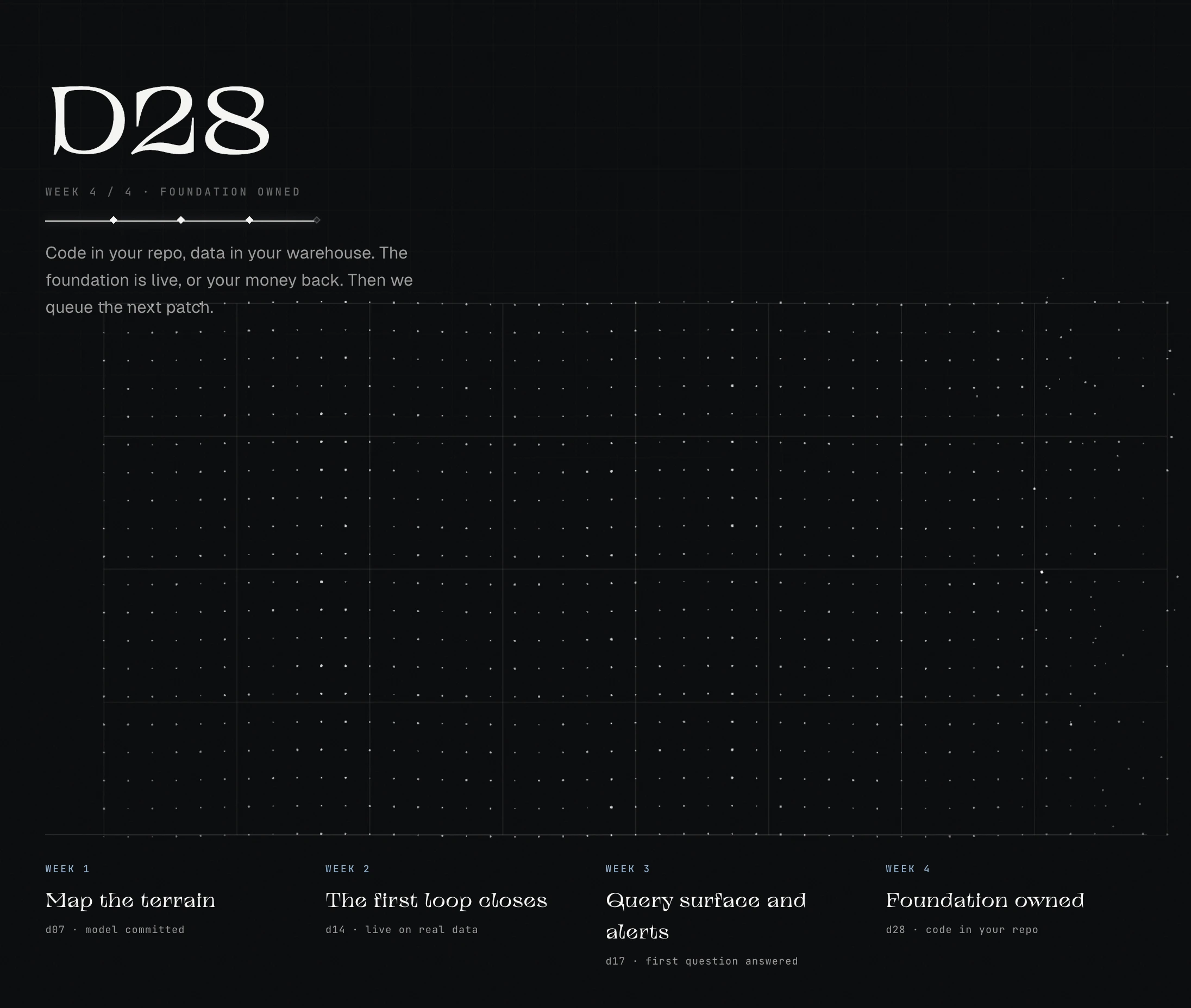
Month one closes the loop. Signal routing by week two.

The build starts at your loudest leak: warehouse live, model joined, the first PQL route firing on production signal. All of it committed to your repo, and guaranteed inside month one.

Week 1

Chart the signal path

Interviews and system reads locate where signal dies today. The warehouse and joined model stand up beneath it.

Week 2

First route fires

The worst leak becomes the first workflow: PQLs scored in the warehouse, routed with context, on live events.

Week 3

One funnel view

Slack alerts and the query surface open to both teams. Growth and sales read the same number from the same model.

Week 4

Loop owned

Definitions, routing, and docs commit to your repo. Foundation live or your money back, next experiment queued.

You own the machine.

Growth teams have been burned by tools that hold the model hostage, so the ownership is structural: the joined model in your warehouse, the PQL definitions and routing workflows in your repo, the runtime on your infrastructure, and enrichment billed at raw API cost with no per-credit markup. Cancel any month and the system keeps running. Your experiments keep training a model you keep.

In production

Real systems, running today.

This loop already runs in production: 30+ owned commercial systems, 270+ workflow patches shipped to client repos, operated week over week.

The next step

Ship the handoff your funnel deserves.

In 20 minutes you'll know where your signal path leaks, what one joined model looks like on your stack, and which PQL route ships first as code you own.

prefer email? contact@workingmono.com